My experiences
I am a former student of the Buddhist teacher Wang Yun (王薀) who recently has received a lot of media attention thanks to two court cases.
In 2015 I left the group and since then I have only informally attended online classes and have only been in loose contact with the group members. This writing is 100% my own view and no one in the group has asked me to support in any way.
Mismatch between reports & the teacher I know
I have always been treated with respect and kindness by both Wang Yun and the other learners in the group. While I am unable to comment with certainty about specific details of the cases, I can say that the stories and allegations in the media do not fit with what I know about Wang Yun and the group. Wang Yun is an astoundingly knowledgeable person and his Buddhist teachings are very much focussed on compassion and kindness. Various media reports claim that Wang Yun held a grudge against Ms Cai because she had lost him a lot of money, and that he ordered regular punishments and the withdrawal of her funds. This does not fit with the teacher I know. Wang Yun strictly avoids using Buddhism as a money-making tool. All the money in the group came from voluntary donations in line with people’s financial means. Some people gave nothing and Wang Yun was still happy to teach them. I never saw financial coercion, and as far as I know there is no clear evidence of financial coercion in this case either.
Repentance and cause and effect
Wang Yun would often advise people to do repentance practices, but they are not punishments born of grudges. In the Tibetan tradition there are various practices that may seem strange or even cruel, but if the teacher or instructor has the right intention, then the idea is often to clear away a person’s bad karma and help them to purify. They are in no way meant to harm the person; they are designed to be of benefit. One may say that the most important precept in Buddhism is that of non-harm. During my time in the group I saw many people practicing, sometimes encouraging each other, but I never saw anyone being vindictive deliberately trying to harm another. The reports and allegations that Ms Cai was tortured and beaten over hours in the building have not been verified by any video footage or proven beyond doubt in any way. The only actual video is of Ms Cai being transported on a trailer. This itself does not prove that she was beaten. Various defendants said that the seminar that evening was from midnight to 1:40 AM, and involved Ms Cai only kneeling twice, not kowtowing and kneeling in repentance for several hours as also described in the press.
Ms Cai was unwell but it is difficult for an average person to diagnose rhabdomyolysis based on appearance alone. The defendents also claim that she was standing again when Wang Yun left the premises. The teacher I know would never leave someone in desperate need of help. I often saw him stay up into the early hours to help people in various ways. One can say that they should have phoned for an ambulance right away and that they should have shown more compassion, but it seems to me that the idea of deliberate harm does not fit with Wang Yun’s teachings or the evidence. It seems highly likely that the media and others have connected the dots to form a much more dramatic and grim picture than actually exists and have then repeatedly pushed this narrative.
Feelings of being controlled
I believe a lot of the negative press around these cases, stem from former students’ feelings of being psychologically controlled. Having been a student, I also experienced this. It then becomes very easy to blame the teacher or the teachings for this until you realise that actually it was you putting the pressure on yourself and then blaming others for it. The respect one has for the person gives their words weight, and that adds to the pressure. But unless there is physical coercion, that pressure is entirely self-created. In all my years with the group I often saw Wang Yun tell people to do things, but never using physical force. Wang Yun treated us with openness and tolerance, and we were all free to go anytime we wanted to. I once heard that Ms Chiang, who the 2nd court case revolves around, was advised to leave and rejoin her family several times but she had refused to go. This fits with what I know of the group, and unless their methods changed while I was away, I believe it’s highly likely that she was free to go at any time but just felt pressured to stay. If so, she has my empathy. Every spiritual teacher needs to be aware of how controlling and strong this inner feeling of pressure can be.
When I left the group, it was extremely difficult psychologically. But after I travelled away no one tried to coerce me into returning, paying money or doing anything. Years later I rejoined the group’s online lessons, because I believe that ancient Buddhist wisdom has even more value now in our modern age. Therefore, I believe that Wang Yun and some other spiritual teachers serve a very important role.
I believe that in addition to the laws of the country, there are two golden rules for any group, and they should be made clear to all members right from the beginning:
- Ahimsa (non-harm) Those in the group must abide by the policy of non-harm.
- Freedom to leave Everyone should feel they are able to leave if they wish to.
These golden principles can help make the beauty and power of devotion safe. When I was in Wang Yun’s group both of these principles were still in place.
The power issue
If too much power and authority rests in the hands of one person, it can become unsafe. That person may lose their ability to make sound judgements or serve their own interests above others creating problems. Therefore, I believe that with regard to groups or traditions like that of Wang Yun’s, with a clear hierarchy, many people are naturally distrusting and apprehensive. Then if something bad happens, this bias can make us see things in such a way as to justify our distrust. Personally though, I never saw Wang Yun abuse his power for his own gain. As an example, in 2015 when I left the group, I offered him a sum of money as thanks, but he refused it.
The responsibility of the media
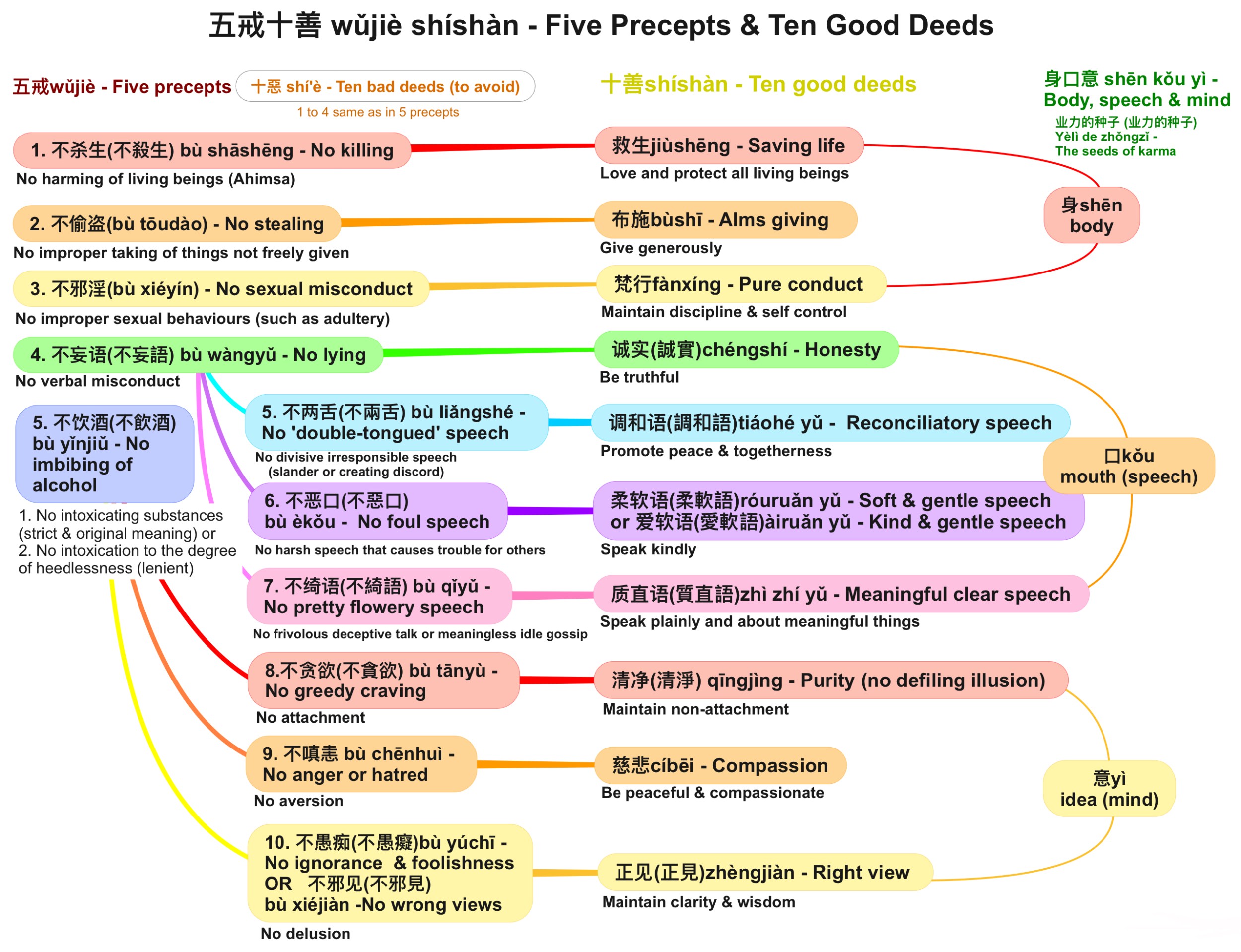
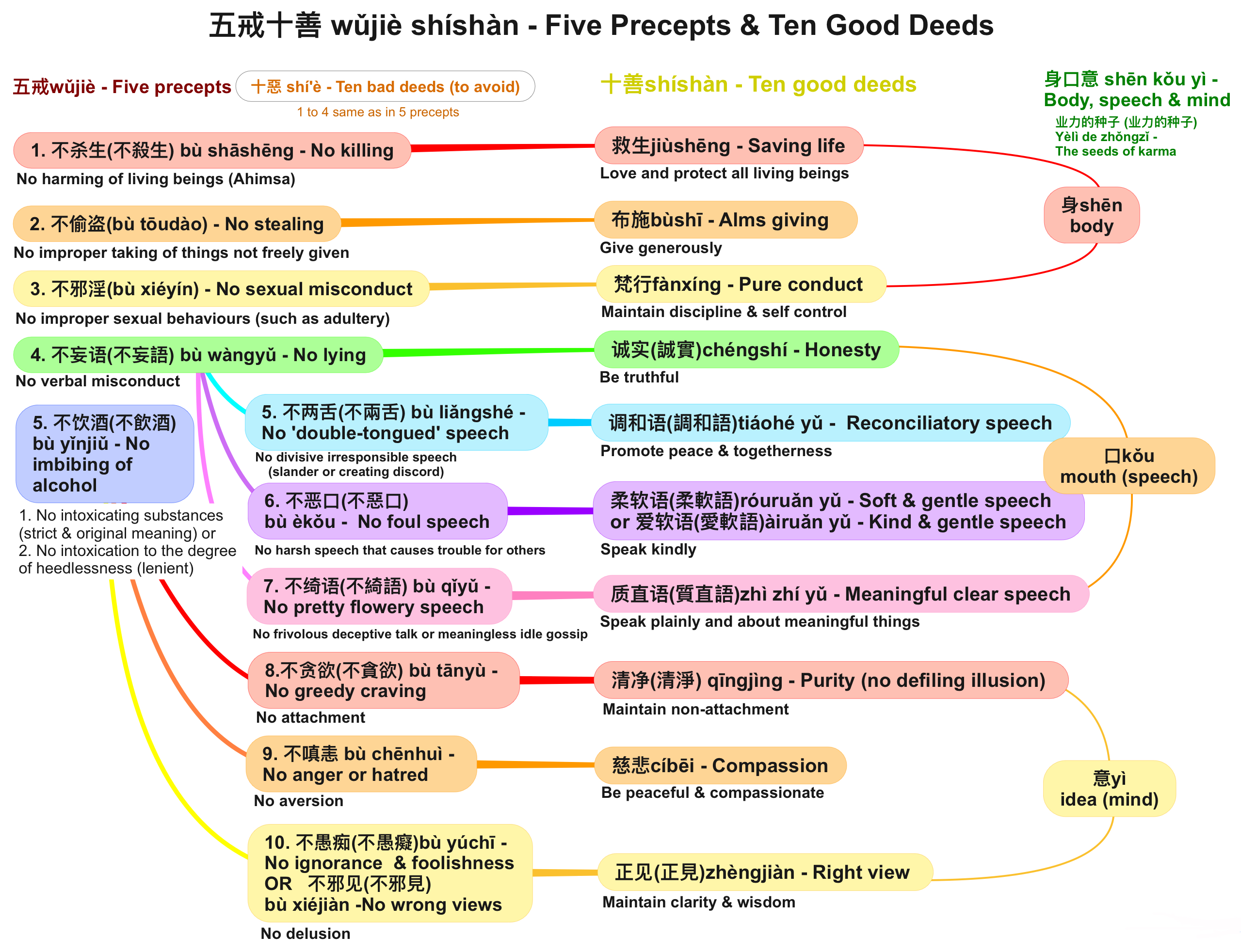
I feel the media have not helped to create a fair and balanced picture. The media thrive on sensation and controversy, and in so doing throw up headlines and stories that paint a much darker and more dramatic picture than actually exists. And in feeding off discord and disharmony they further deepen that discord and disharmony. The media have a huge responsibility. I believe that reading the ‘Five precepts and ten good deeds’ (五戒十善) would be of huge value to those in the media. From a Buddhist perspective, if they can present the truth in a fair balanced way while encouraging harmony, peaceful relations and building trust, they can create good karma. If they distort the picture to dramatize while creating distrust, the karma from that is unspeakable. Buddhist concepts aside, freedom of speech is a hard-earned precious thing, abuse it and you may lose it. The more freedom you have, the more self-control you need.
The negative media bias is so strong that there is little to no mention of the various good things that the group have done. Under Wang Yun’s guidance, the group delivered lunch boxes to the elderly and those in need while keeping them company, cleaned beaches, released animals and much more. Wang Yun has kept a low profile for many years but has made truly profound contributions to Buddhism and society. He has been like an underground stream that helps to keep the grass green. It’s easier to see the things that went wrong than all the things that went right.
I have sent this text to various media sources. Any media source, newspaper or website that shows this text thereby also shows that it can openly include other voices and perspectives, a valuable strength.
Ms Cai
Ms Cai was such an incredible student, full of energy and goodwill, much loved and respected by many in the community. She was diligent, cheerful, friendly, devoted, and enthusiastic in her practice and shall be hugely missed! I also believe that she would be appalled at the treatment of her teacher and fellow students. It is my prayer that she is in a pure auspicious place and can carry on with her energetic practice. I wish her family all the best, and hope that through peaceful reflections they can turn their sadness into something beautiful.
Summary
This article expresses only my own experiences and views. I am unable to comment about what other people have experienced and am not saying there is an absence of wrongdoing, just that the evidence needs to be presented without distortion and bias to create a fair and balanced picture. Praying that this situation can be resolved as smoothly, peacefully and fairly as possible.
中文版請點這裡 For Mandarin version click HERE