Personal Light Electric Vehicles Interactive Decision Matrix Comparison Charts

Thinking of buying an electric scooter or other transport tool? This is where you can numerically compare Personal Light Electric Vehicles‘ (PLEVs) based on your own specific needs. At the time of writing there is nothing like this anywhere else online. To understand how a decision matrix works see the 2 minute video below and then read on:

In the interactive self-adjusting decision matrix below, transport tools are shown in the left column and factors (considerations) are on the top row. For every factor you can enter a weighting (importance value) from 0 (totally unimportant) to 10 (essential). Just replace the default weighting of 5 with your own weighting (from 1 to 10).  For example, if you feel ‘Portability’ is quite important you might give it a weighting of 7. If you feel ‘Top Speed’ is fairly unimportant you might give it a weighting of 2. For each factor (consideration) a transport tool already has an achievement score which is how well it performs in that factor area. The achievement score is based on OBJECTIVE data (see base of table for explanations). For example, the Urmo gets a low achievement score of 2.5 for the ‘Top speed’ factor because it’s fairly slow. The objective achievement score is multiplied by your subjective weighting to produce a weighting x achievement score. So for the Urmo in the ‘Top speed’ category it would be 2 (your weighting) x 2.5 (achievement score) = 5 (weighting x achievement score). The overall score for each gadget is the sum total of all weighting x achievement scores. The tool with the highest score is likely to be the most suitable based on your needs. The table will update automatically as you enter the importance values (weightings).

See below for a quick example video (the chart no longer works on the webpage as shown in the video so just use the buttons below to open it in Google Sheets or Excel):

A STATIC (NON-INTERACTIVE) COMPARISON TABLE (LIGHTWEIGHT PORTABLE TRANSPORT TOOLS)

UPDATE 2025
Having used the tables above to buy and try various transport tools I have settled on using my Micro Falcon scooter for short distance last mile transport. It rolls beautifully in active mode and actively kicking it along helps pedestrians to feel more at ease although usually I get off and walk past oncoming pedestrians. In places where escooters are banned so far I have always used the excuse that it is a ‘hybrid’ and so far that has worked. It’s so small and portable that it’s just less of an issue and I believe this has fantastic potential as an urban transport tool. It’s out of production at present but I hope that Micro produce an upgraded version with a light, a softer front tire and deck (I add jelly mats and rubber to help cushion the ride).
Also The Urmo is not currently available and production plans have come to a halt. ‘Zoom’ company seems to be out of business now. Also various other scooters not included here have been highly rated on Electric Scooter Guide.com so check them out as well HERE if interested. 

SAFETY UPDATE IN 2021 – MAKE SURE THE STEM IS LOCKED IN BEFORE RIDING! The handlebar stem on my Kugoo S1 Pro once gave way while riding. I had already gone a couple of miles on it when it came loose. It’s possible that I didn’t click it in properly or it may have come loose while riding. The result was not pretty. The handlebar is a reason why scooters outperform most other transport tools in safety, but be sure you check the handlebar stem is fully locked in place before riding, avoid riding at speed over rough terrain or at least check the stem lock after doing so. Also buy a scooter with an effective stem lock! NOTE: The Kugoo S1, both E-TWOW scooters and the Micro Explorer all use the same basic frame with the same stem lock!

For scooter rental schemes

If you are looking here for a scooter to use in a rental scheme with a capped speed lower than all the top speeds of the scooters shown then you should enter ‘0’ as a weighting (importance value) for the speed factor. Likewise, you may wish to give ‘portability’ a lower weighting given that most users will dock their scooters rather than push or carry them around.

If you would like us to make a revised matrix with additional factors specific to your rental scheme or with other transport tools added just let us know – happy to help! 

OLDER CONTENT SHOWN BELOW

We believe that we now need to embrace lightweight portable transport to help slow global warming, boost people’s well-being through cleaner air & maintaining a safe social distance.

To see mindmaps showing pros and cons of different transport gadgets click HERE

Some older gadgets – a comparison chart made in 2015

ELPT, Electric Lightweight Portable Transport Tools, Electric Mobility Devices

Download
PDF: Transportables
Word File: Transportables

Gadget names

I suggested ‘Transportables‘ (transport tools that are portable)
& also ‘Lightweight Portable Transport‘ (LPT).
Here are some competing names:
Personal transport gadgets (PTGs?)
Personal Light Electric Vehicles‘ (PLEVs) (the term used by the UK government),
Powered Transporters‘,
Rideables‘ (possibly from Wired magazine).

”EUCS” or ”electric unicycles” involve no cyling so it’s a misnomer. Much better to call them Electric self-balancing wheels, electric wheels or just ewheels. Another suggestion I saw was motor wheels.
Personal Light Electric Vehicles (Specs Comparison Charts)

BELOW IS THE OLD VERSION OF THIS POST – TO SEE THE NEW UPDATED VERSION SEE OUR TRANSPORT WEBSITE HERE: https://greentransportideas.org/2020/07/27/transportables-portable-transport-tools/

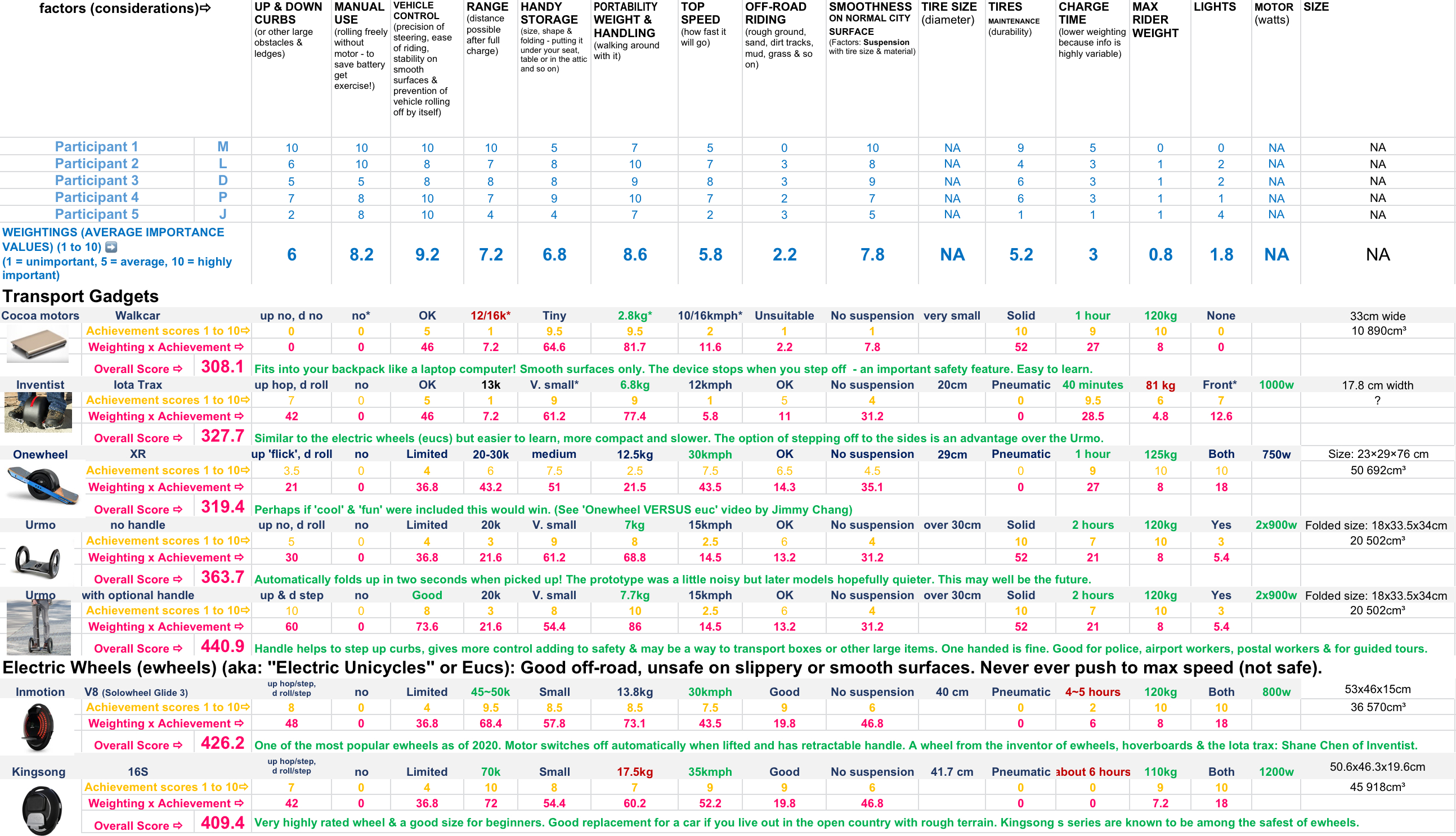
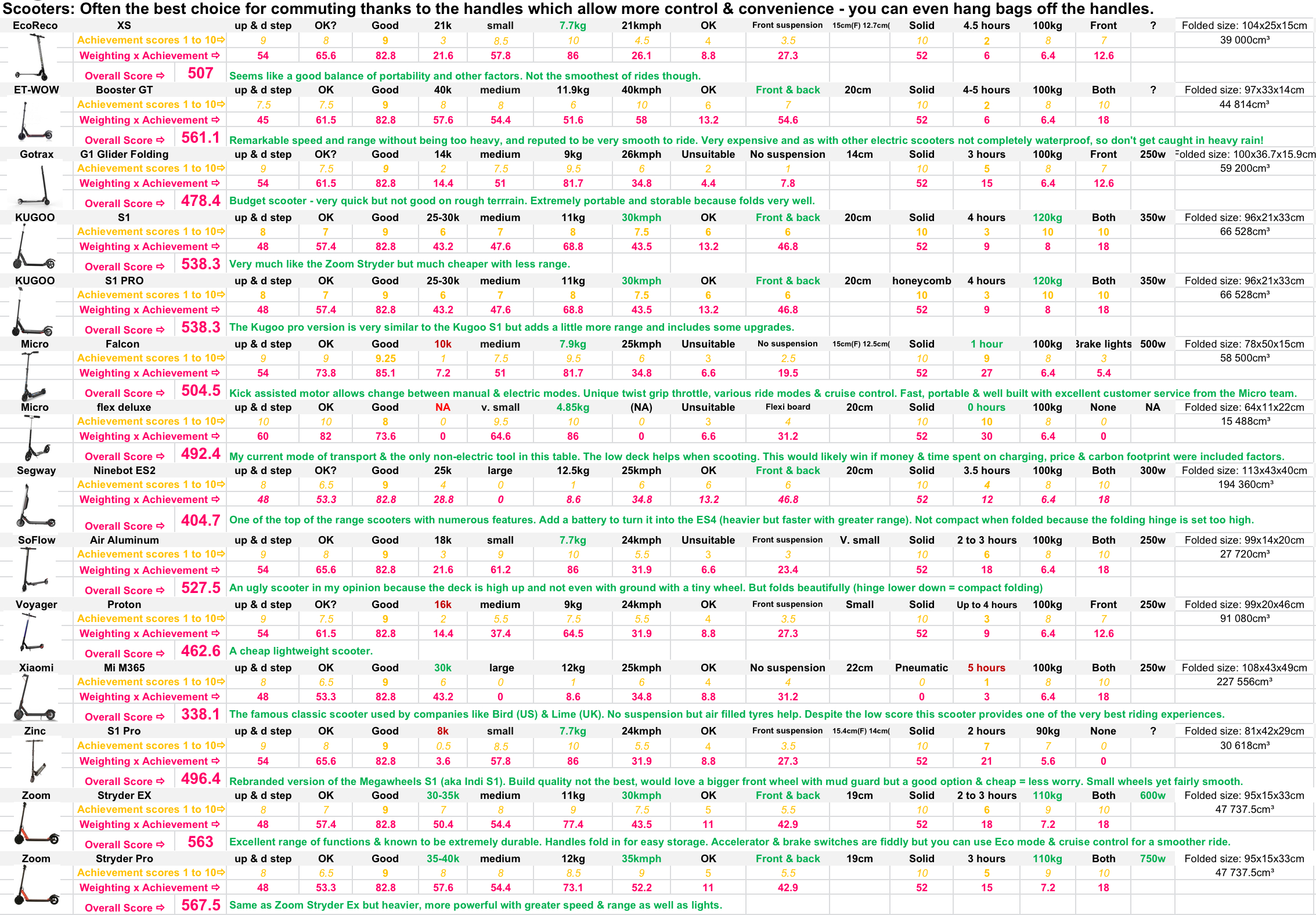
Here is an attempt at providing the most rigorous, objective and accurate evaluative comparison of LPT (lightweight portable transport) gadgets to date (2020). They are rated as commuting tools using an extension of the ‘Pugh matrix’ known as the Group Average Matrix Evaluation (GAME) system invented by the author (Luc). Transport tools are in the left column & factors (considerations) are on the top row. Each factor has a weighting (importance value) which is the average importance number given by participants. For example, participants saw the portability factor as important so gave it high importance numbers with an average of 8.6 (weighting). The top speed factor was seen as less important & the average is just 5.8 (weighting). For each factor a gadget is given an achievement score which is how well it performs in that factor area. For example, the Urmo with a handle gets a perfect achievement score of 10 for the portability factor because it’s so light, small & can be pushed by the handle. The achievement score is multiplied by the weighting to produce a weighting x achievement score. So for the Urmo in portability it’s 8.6 (weighting) x 10 (achievement score) = 86 (weighting x achievement score) . The overall score for each gadget is the sum total of all weighting x achievement scores.

PLEVs LPT Transport gadgets comparison chart table 1
PLEVs LPT Transport gadgets comparison chart table 2
PLEVs LPT Transport gadgets comparison chart table 3

This will likely be regularly updated in future so best to come back to this page once in a while.To view or download a PDF of the above chart click HERE

LIGHTWEIGHT PORTABLE TRANSPORT TOOLS – INTERACTIVE COMPARISON CHART USING THE SELF-ADJUSTING MATRIX EVALUATION (SAME) SYSTEM (also invented by the author)

So which gadget is right for you personally or for your rental scheme? Simply click on the interactive chart below & enter your own weightings (importance values) for the factors. The scores automatically adjust every time you enter a value & when complete each tool will have an overall score to show how suitable it is likely to be for you.  We’re attempting the impossible – it will never be 100% accurate or comprehensive but should give you a clear objective picture on which to base your intuition. Just replace the default weighting of 5 with your own weighting (from 1 to 10).  Works best with a touchscreen – just swipe within the chart to move around. You can also use the scroll bar within the chart or arrow keys to move around. Your amendments will be reset if you leave this page. For more exact instructions swipe or scroll to the top of the chart.

For scooter rental schemes

If you are looking here for a scooter to use in a rental scheme with a capped speed lower than all the top speeds of the scooters shown then you should enter ‘0’ as a weighting (importance value) for the speed factor. Likewise, you may wish to give ‘portability’ a lower weighting given that most users will dock their scooters rather than push or carry them around. We advocate giving ‘manual use’ (pushing with feet) a high weighting given the importance of exercise, convenience of carrying on if out of charge. Using electric scooters manually can also help oncoming pedestrians to feel more at ease (personal experience) and a lightweight scooter suitable for manual use may also translate into enhanced pedestrian safety. Factors contributing to  ‘manual use’ but not included in the matrix are ‘deck height’ and ‘degree of roll resistance’. A low deck and minimal roll resistance allow a scooter to be used manually.  Among others ET-WOW scooters (AKA uscooters) seem especially suitable in this regard and they are being promoted as suitable scooters for rental schemes. Furthermore some of the ET-WOW scooters have received top ratings from users – see HERE.

If you would like us to make a revised matrix with additional factors specific to your rental scheme just let us know – happy to help. 

UPDATE JULY 2020 – The ‘Zoom’ company seems to be out of business now. Also various other scooters not included here have been highly rated on Electric Scooter Guide.com so check them out as well HERE if interested. 

We believe that we now need to embrace lightweight portable transport to help slow global warming, boost people’s well-being through cleaner air & maintaining a safe social distance while avoiding enclosed spaces with others. If you agree & wish to see more electric devices such as scooters legalised for personal use as well as in rental schemes then please sign this petition: http://chng.it/JgCQNW2pZW

To see mindmaps showing pros and cons of different transport gadgets click HERE

Some older gadgets – a comparison chart made in 2015

ELPT, Electric Lightweight Portable Transport Tools, Electric Mobility Devices

Download
PDF: Transportables
Word File: Transportables

So what should we call these things? I suggested:
Transportables‘ (transport tools that are portable)
& also ‘Lightweight Portable Transport‘ (LPT).
Here are some competing names:
Personal transport gadgets (PTGs?)
Personal Light Electric Vehicles‘ (PLEVs) (the term used by the UK government),
Powered Transporters‘,
Rideables‘ (possibly from Wired magazine).

OLD POST ”Hoverboards” (Self-Balancing Foot Scooters)

lean machines, hovertrax, Solowheel, Balance Boards, Balance Scooters, Foot Scooters, chic-smart, esway, iohawk, monorover R2, SmartraxS5,

It’s about time we each take responsibility for saving our climate & stand on our own two wheels! The chart below was made in 2015, see menu for an updated version with far more information.

Note: table is based on information online in 2015. Phunkeeduck details may be incorrect – received no response from the company to confirm. If you see any errors or have any useful suggestions please let me know.

Download this table
Lean Machines PDF
Lean Machines Word file

See this post in Mandarin Chinese (看中文版)

In case you plan to buy one and intuition isn’t telling you which one to go for then you can make a decision matrix using the table. A great technique if it’s done well. Click below to see an example.

Lean Machines Decision Matrix

The text below is really important if you’re going to learn to ride a self-balancing scooter. It’s based on my own experiences learning the Hovertrax.

Learning to Ride an Electric Self-balancing Scooter

Self-balancing electric foot scooters are fun and convenient but not as safe as you might think. It’s essential that you master the following steps before even considering riding beside a road, in a busy public place or other challenging environment.
When learning you will need a safe place with lots of space and a large open flat surface such as a running track, the center of a gymnasium, a tennis court or a playground.

Before going out with your scooter
1. Understand the functions
Read the manual and other information carefully and make sure you know how to turn it on, off, and so on.
2. Understand the concept
Before you hop on, be sure you understand the concept of how it works and can visualise how the angles of the feet correlate with speed and turning.
Tilt forward = go forwards.
Tilt back = go backwards.
Right tilt forwards, left back = turn left
Left tilt forwards, right back = turn right
You can practice angling and turning your hands or sit on a chair or edge of a bed putting your feet on the device while it’s switched off pretending you’re riding.

step off foot scooter 2

In a safe practice location
3. Getting on
Put your dominant foot level on the scooter and bring the other foot up quickly.
4. Getting off
Step off behind the scooter keeping one foot level on the platform to prevent the scooter rolling away.
5. Stopping
Practice regular stopping as well as abrupt stopping at high speeds. For high speed stopping as you tilt your feet back crouch down with hands level to the ground until you reach a stop. You should aim to be able to come to a complete stop in the shortest possible distance (about 1 to 1.5 m for the Hovertrax at near top speed).
6. Turning
Practice turning on the spot (one foot tilting back, the other tilting forward) and turning at speed (one foot level, the other tilting forward). You could use plant pots or other such objects to form a practice slalom course.
7. Reversing
Practice going backwards.
8. Reversing & turning
Practice going backwards and turning.
9. Stepping off while moving
Many foot scooters may get stuck on rough terrain. To prepare for this learn to step off while going at speed. Be extra careful because if when you step off your foot pushes down on one side of the platform the scooter will move in the corresponding direction. It could zoom out from under your feet or even back under your feet.
Go slowly in a straight line and then while moving take a quick and little step putting one foot in front of the machine resting on your toes with the heel up. Then follow with a larger step with your other foot flat on the ground. The first foot should stabilize you and stop the machine from rolling on as it goes into the sole of your shoe.
10. Speed & stability
Only once you’re ready and have fully mastered the other steps should you very carefully and very gradually have a go at seeing how fast you can go safely maintaining stability. Take multiple goes, each time increasing your speed a little more. Once the speed control tilts you back, or the device strains or wobbles then slow down right away. You must never try to increase the speed beyond this point otherwise the device may not have enough power to keep up with your leaning and you could fall.
At speed you must make absolutely sure that you keep both feet as level as possible on the platforms to keep a straight line.

Summary

  1. Understand the concepts and the machine.
  2. Try doing the basic things until they become natural.
  3. Only then progress toward the more advanced things.

Download the above text as a PDF:
Learning to ride an electric self-balancing scooter

Links
See here for a comparison table of self-balancing electric Wheels like the Solowheel

Imagine if we saved the environment, peoples health and lives by simply making a selected few streets in large cities car-free giving them over to bikes and lightweight portable transport

Great video review of Solowheel, Hovertrax, Phunkeeduck & the zBoard Pro

中文版請點這裡 For Mandarin version click HERE

OLD POST Self-Balancing eWheels (“eucs”) & Foot Scooters (“hoverboards”)

Update in 2022 

I no longer promote the use of ewheels (eucs) given that manufacturers are now making them with such high top speeds which is obviously completely unsafe. So focus is likely to be on scooters, other gadgets and urban commuter systems from now on.

Update in 2020: The Kingsong S series of eWheels are known now to be among the safest. Safety should be your top priority. The Inmotion ewheels also have a good reputation & are the rebranded versions of the original Inventist wheels (such as the Solowheel). Airwheel & various other brands are known to be cheap & of lower quality. A new updated table will hopefully appear here soon but for now see HERE

Below is an old post with outdated information 

New terminology suggested by the Peacemaker Foundation

The new inventions are great, but our names for them are not: electric “unicycles” are not unicycles because they involve no cycling. “Hoverboards” don’t hover and they’re not boards. Furthermore when real hoverboards appear it will become even more confusing. Here are some suggested names:

Electric wheel or eWheel (electric self-balancing “unicycle” or “euc”)
Electric Foot Scooter (Self-balancing Dual Motor Electric Foot Scooter – a “hoverboard”) 
LPT
 (Lightweight Portable/Personal Transport: transport involving devices that can be easily carried)
Transportable (Portable transport tool)

Self-balancers (self-balancing transport tools – as listed above)

If you can think of better names then please comment or get in touch.

Specs for some of the latest eWheels & electric foot scooters

Viewable PDF format 

Download

Word File: Electric Wheels Compared (February 2015)

PDF: Electric Wheels Compared (February 2015)

Winners Podium   
Gold medal: Solowheel Orbit and Solowheel Extreme each are the winners in three categories, but they are also the most expensive.

Silver medal: Firewheel and Rockwheel also do quite well with each one winning in two categories. Hovertrax wins two categories as well but loses in four – just depends which categories are more important for you.

Bronze medal: What do you reckon? Perhaps Freeman A4.

Update: Recently a very promising and popular eWheel has been the Gotway which will certainly appear in the next edition of this table.

Author’s opinion

Personally I like the electric foot scooters because they’re easier to learn (apparently) so I bought Hovertrax which is great fun and very well built although it lacks stability at speed and only works well on smooth surfaces. If you have enough money and you value patent ethics you might wish to buy from Inventist seeing as they hold the patents. Furthermore, as of January 2015 the Solowheels generally gets the best reviews, such as on Amazon.

Great Electric Wheel Videos

I’ve looked around so you don’t have to. Here are some links to some great videos.

Fantastic review of Solowheel, Hovertrax, Phunkeeduck & the zBoard Pro. Also shows how important it is to ride carefully!
https://www.youtube.com/watch?v=JD1xBI6TK50

Fun advert for the solowheel
https://www.youtube.com/watch?v=YQjUouUhaiU

The Solowheel in London
https://www.youtube.com/watch?v=s_KFIT8nWF8

Fun advert for Ninebot 1
https://www.youtube.com/watch?v=1Pu9uz40YdA

Super slick super cool ad for Ninebot 1
https://www.youtube.com/watch?v=ostYmeUs3VU

Fun advert for IPS F400
https://www.youtube.com/watch?v=sPu-amSMs7U

Airwheel Mail Delivery
https://www.youtube.com/watch?v=MAlDe1DOU3A

Airwheel stunts
https://www.youtube.com/watch?v=tz05Cyzuo1Y

More Airwheel stunts
https://www.youtube.com/watch?v=YdEHOdCBCmo

Foot Scooter videos

Hovertrax
https://www.youtube.com/watch?v=vA11YG1WB7A

Chic-smart video from Korea
https://www.youtube.com/watch?v=MfZpNILDhk8

Links
Lean Machines: Comparison Table of Self-Balancing Dual-Motor Electric Foot Scooters

Transportables:comparison chart of lightweight portable transport tools including the Solowheel & Hovertrax

Green Lanes: car-free streets open to eWheels, bikes, and other forms of LPT (lightweight portable transport)  

中文版請點這裡 For Mandarin version click HERE