If the PDF below does not display on your device then scroll down to see the JPEG version & clickable references list.
JPEG version
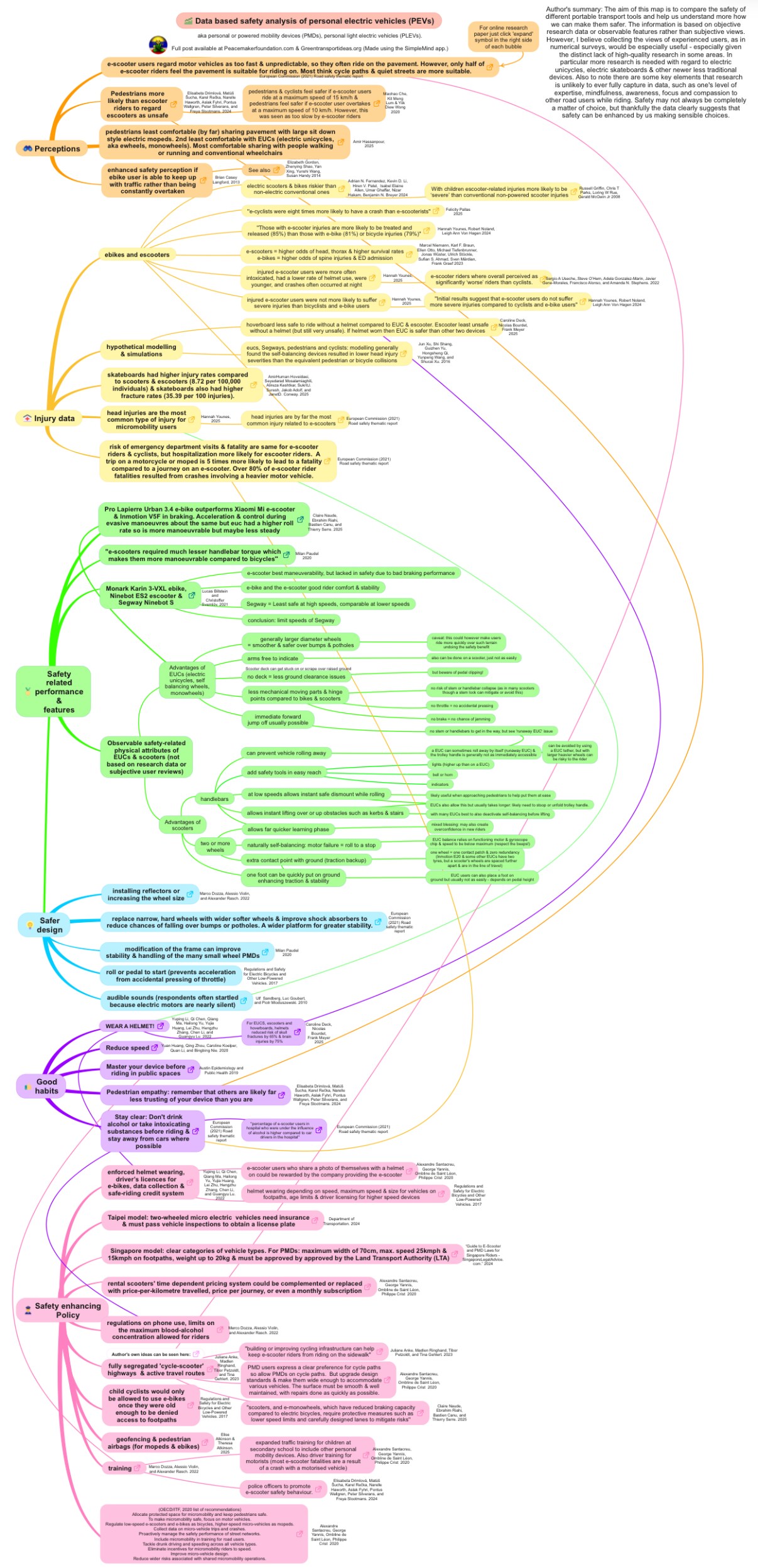
REFERENCES
Adrian N. Fernandez, MD1; Kevin D. Li, BS1,2; Hiren V. Patel, MD, PhD1 Isabel Elaine Allen, PhD2; Umar Ghaffar, BS1; Nizar Hakam, MBBS1; Benjamin N. Breyer, MD, MAS1, “Injuries with Electric vs Conventional Scooters and Bicycles.” JAMA Network Open 7 (7): e2424131. https://doi.org/10.1001/jamanetworkopen.2024.24131.
Alexandre Santacreu, George Yannis, Ombline de Saint Léon, Philippe Crist 2020. “Safe Micromobility.” ITF. January 9, 2020. https://www.itf-oecd.org/safe-micromobility.
Amir Hassanpour, 2025. “Human-Electric Hybrid Vehicles : Implications of Emerging Personal Mobility Devices for Street Design and Policy.” Doi.org, March. https://doi.org/10.14288/1.0449383.
AmirHuman Hoveidaei, Seyedarad Mosalamiaghili, Alireza Keshtkar, SukritJ. Suresh, Jakob Adolf, and JanetD. Conway. 2025. “Orthopaedic Fractures in Skateboard, Scooter, and E-Scooter Injuries: A Nationwide Study in the U.S. (2010–2022).” Injury 56 (7): 112361. https://doi.org/10.1016/j.injury.2025.112361.
Austin Epidemiology and Public Health Preparedness division, “Dockless electric scooter-related injuries study’’ September – November 2018, published April 2019. https://www.austintexas.gov/sites/default/files/files/Health/Web_Dockless_Electric_Scooter-Related_Injury_Study_final_version_EDSU_5.14.19.pdf.
Brian Casey Langford, “A comparative health and safety analysis of electric-assist and regular bicycles in an on-campus bicycle sharing system.. ” PhD diss., University of Tennessee, 2013.
https://trace.tennessee.edu/utk_graddiss/2445
Caroline Deck, Nicolas Bourdet, Frank Meyer 2025, ‘‘Safety and Risk Mitigation in Emerging Urban Mobility: A Study on Head Trauma and Helmet Effectiveness for Personal Electric Vehicles.’’ IRCOBI conference, IRC-25-128
https://www.ircobi.org/wordpress/downloads/irc25/pdf-files/25128.pdf
Claire Naude, Ebrahim Riahi, Bastien Canu, and Thierry Serre. 2025. “Longitudinal and Lateral Performances of Electrically Assisted Personal Mobility Vehicles: A Comparative Field Test Analysis of E-Scooter, E-Bicycle, and E-Monowheel.” Transportation Engineering 22 (December): 100404. https://doi.org/10.1016/j.treng.2025.100404.
Department of Transportation. 2024. “Mandatory Licensing for Micro Electric Two-Wheel Vehicles Starting November 30, 2024.” Department of Transportation. December 25, 2024. https://english.dot.gov.taipei/News_Content.aspx?n=3C4F5FC3FD2929A0&s=2C5DCCD216205577&utm_source=chatgpt.com.
Elisabeta Drimlová, Matúš Šucha, Karel Rečka, Narelle Haworth, Aslak Fyhri, Pontus Wallgren, Peter Silverans, and Freya Slootmans. 2024. “Attitudes towards E-Scooter Safety – a Survey in Five Countries.” Transactions on Transport Sciences, August. https://doi.org/10.5507/tots.2024.009.
Elise Atkinson and Theresa Atkinson. 2025. “Injury Patterns and Safety Implications for Electric Bikes Compared to Mopeds in the United States.” Traffic Injury Prevention, August, 1–9. https://doi.org/10.1080/15389588.2025.2543497.
“European Road Safety Observatory Road Safety Thematic Report Personal Mobility Devices.” n.d. https://road-safety.transport.ec.europa.eu/system/files/2021-07/road_safety_thematic_report_personal_mobility_devices_tc_final.pdf.
Felicity Pallas 2025. “E-Bikes and E-Scooters in the UK: New Research Challenges Safety Assumptions.” Brownejacobson.com. Browne Jacobson. September 30, 2025. https://www.brownejacobson.com/insights/the-word-september-2025/ebikes-escooters.
“Guide to E-Scooter and PMD Laws for Singapore Riders – SingaporeLegalAdvice.com.” 2024. SingaporeLegalAdvice.com. August 29, 2024. https://singaporelegaladvice.com/law-articles/e-scooter-laws-singapore/.
Hannah Younes, 2025. “Comparing Injuries from E-Scooters, E-Bikes, and Bicycles in the United States.” Journal of Cycling and Micromobility Research 4 (February): 100061. https://doi.org/10.1016/j.jcmr.2025.100061.
Hannah Younes, Robert Noland, Leigh Ann Von Hagen 2024 “Are E-Scooter Users More Seriously Injured than E-Bike Users and Bicyclists? – New Jersey State Policy Lab.” New Jersey State Policy Lab https://policylab.rutgers.edu/publication/are-e-scooter-users-more-seriously-injured-than-e-bike-users-and-bicyclists/.
Juliane Anke, Madlen Ringhand, Tibor Petzoldt, and Tina Gehlert. 2023. “Micro-Mobility and Road Safety: Why Do E-Scooter Riders Use the Sidewalk? Evidence from a German Field Study.” European Transport Research Review 15 (1). https://doi.org/10.1186/s12544-023-00607-z.
Jun Xu, Shi Shang, Guizhen Yu, Hongsheng Qi, Yunpeng Wang, and Shucai Xu. 2016. “Are Electric Self-Balancing Scooters Safe in Vehicle Crash Accidents?” Accident Analysis & Prevention 87 (February): 102–16. https://doi.org/10.1016/j.aap.2015.10.022.
Luc. 2025. “Transport Proposals – the Peacemaker Foundation.” The Peacemaker Foundation. August 22, 2025. https://peacemakerfoundation.com/category/world-health/transport-proposals/.
Lucas Billstein and Christoffer Svernlöv. 2021. “Evaluating the Safety and Performance of Electric Micro-Mobility Vehicles: Comparing E-Bike, E-Scooter and Segway Based on Objective and Subjective Data from a Field Experiment.” Chalmers.se. 2021. https://odr.chalmers.se/items/c5639720-3b18-4524-a1be-50c9b4884e6e.
Maohao Che, Kit Meng Lum, and Yiik Diew Wong. 2020. “Users’ Attitudes on Electric Scooter Riding Speed on Shared Footpath: A Virtual Reality Study.” International Journal of Sustainable Transportation 15 (2): 152–61. https://doi.org/10.1080/15568318.2020.1718252.
Marcel Niemann, Karl F. Braun, Ellen Otto, Michael Tiefenbrunner, Jonas Wüster, Ulrich Stöckle, Sufian S. Ahmad, Sven Märdian, Frank Graef 2023. “Dangers of E-Mobility: A Systematic Review and Meta-Analysis of Sustained Injury Patterns and Injury Severity.” Safety Science 167 (July): 106283. https://doi.org/10.1016/j.ssci.2023.106283.
Marco Dozza, Alessio Violin, and Alexander Rasch. 2022. “A Data-Driven Framework for the Safe Integration of Micro-Mobility into the Transport System: Comparing Bicycles and E-Scooters in Field Trials.” Journal of Safety Research, February. https://doi.org/10.1016/j.jsr.2022.01.007.
Milan Paudel 2020. “An Investigation into the Design for Rideability of Small Wheel Single-Track Bicycles and E-Scooters,” October. https://doi.org/10.32657/10356/140129.
Natalie Popovich, Elizabeth Gordon, Zhenying Shao, Yan Xing, Yunshi Wang, Susan Handy. 2014. “Experiences of Electric Bicycle Users in the Sacramento, California Area.” Travel Behaviour and Society 1 (2): 37–44. https://doi.org/10.1016/j.tbs.2013.10.006.
“Regulations and Safety for Electric Bicycles and Other Low-Powered Vehicles.” 2017. https://www.nzta.govt.nz/assets/resources/research/reports/621/621-regulations-and-safety-for-electric-bicycles-and-other-low-powered-vehicles.pdf.
Russell Griffin, Chris T Parks, Loring W Rue, Gerald McGwin Jr 2008. “Comparison of Severe Injuries between Powered and Nonpowered Scooters among Children Aged 2 to 12 in the United States.” Ambulatory Pediatrics 8 (6): 379–82. https://doi.org/10.1016/j.ambp.2008.08.002.
Sergio A Useche,.Steve O’Hern, Adela Gonzalez-Marin, Javier Gene-Morales, Francisco Alonso, and Amanda N. Stephens. 2022. “Unsafety on Two Wheels, or Social Prejudice? Proxying Behavioral Reports on Bicycle and E-Scooter Riding Safety – a Mixed-Methods Study.” Transportation Research Part F: Traffic Psychology and Behaviour 89 (August): 168–82. https://doi.org/10.1016/j.trf.2022.06.015.
Ulf Sandberg, Luc Goubert, and Piotr Mioduszewski. 2010. “Are Vehicles Driven in Electric Mode so Quiet That They Need Acoustic Warning Signals?” https://acoustics.asn.au/conference_proceedings/ICA2010/cdrom-ICA2010/papers/p997.pdf.
Yuan Huang, Qing Zhou, Caroline Koelper, Quan Li, and Bingbing Nie. 2020. “Are Riders of Electric Two-Wheelers Safer than Bicyclists in Collisions with Motor Vehicles?” Accident Analysis & Prevention 134 (January): 105336. https://doi.org/10.1016/j.aap.2019.105336.
Yuping Li, Qi Chen, Qiang Ma, Hailong Yu, Yujia Huang, Lei Zhu, Hengzhu Zhang, Chen Li, and Guangyu Lu. 2022. “Injuries and Risk Factors Associated with Bicycle and Electric Bike Use in China: A Systematic Review and Meta-Analysis.” Safety Science 152 (August): 105769. https://doi.org/10.1016/j.ssci.2022.105769.
Author’s subjective opinion
For me personally when I see the horrible carbon footprint and pollution created by cars, I just want to see more green transport, especially PEVS, which are generally far more energy efficient than larger vehicles. I just feel we need to improve the safety somehow. This visual is an attempt to help by raising understanding. Also I feel a little less focus on speed and a little more on safety from manufacturers, plus more cycle scooter highways and active travel routes would be a huge help in that way.
Transparency & ethical ‘self-balanced’ use of AI: Mind & learning over technology
The reference list above was compiled using https://www.mybib.com/tools/chicago-citation-generator
The author (Luc) made the visual map over many hours without use of AI & researched mainly using Google Scholar (with some occassional help from ChatGPT)


